ZHINGKHAM EXCURSIONS • BESPOKE
Bespoke Excursions
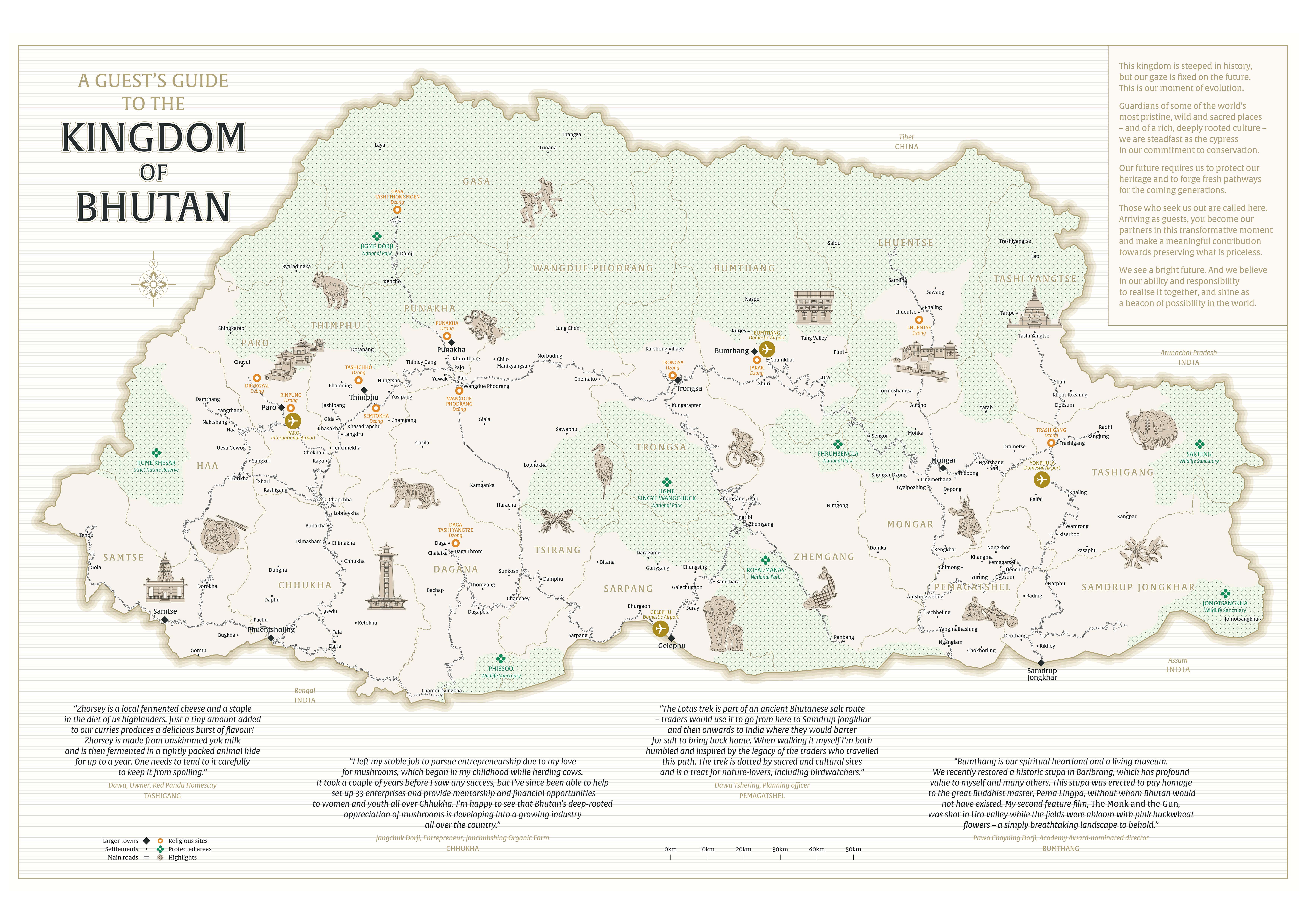
This is not a fixed itinerary. It is a curated map of Bhutan — all 20 Dzongkhags, thoughtfully described — so you can build your route around slow cultural immersion, high-mountain passes, wildlife corridors, craft villages, rituals, and landscapes beyond the obvious.
Map reference: Department of Tourism, Bhutan
Western Bhutan
Western Bhutan is where first impressions become lasting memories: fortress monasteries above river bends, living craft traditions, and the most iconic sacred landscapes. It’s perfect for travellers who want culture, comfort, and Bhutan’s defining highlights — without rushing.
PARO • WEST
Paro — Sacred icons, valley heritage, and Bhutan’s most dramatic monastery
Paro is Bhutan’s most iconic valley — not because it is “touristy,” but because it holds the deepest symbols of Bhutanese identity. The Taktsang Monastery (Tiger’s Nest) is the obvious highlight, yet Paro’s real power is in the way daily life and sacred geography overlap: prayer flags across ridges, slow rivers, and whitewashed temples set into farmland.
The valley’s heritage is anchored by Rinpung Dzong, a fortress-monastery with commanding views, and the National Museum (Ta Dzong), which offers context for Bhutan’s art, textiles, weaponry, and belief systems. Kyichu Lhakhang, one of Bhutan’s oldest temples, is quietly profound — less dramatic than Tiger’s Nest, but often more intimate.
Best for: culture + sacred sites • photography • gentle valley walks • first-time Bhutan travellers.
THIMPHU • WEST
Thimphu — The capital, but still unmistakably Bhutan
Thimphu is a capital city that doesn’t behave like one. It is where Bhutan’s governance, monastic authority, and contemporary life converge — and yet the rhythm remains human-scale. Tashichho Dzong represents the state and the central monastic body. The Memorial Chorten is where devotion is lived daily — locals circle it with prayer wheels and quiet intention.
For broad valley perspective, Buddha Dordenma offers a panoramic viewpoint and a feeling of scale. Thimphu also shines in its living culture: craft traditions, weekend market life, small galleries, and local cafés where modern Bhutan reveals itself naturally.
Best for: modern + traditional blend • craft and culture • day excursions to viewpoints.
PUNAKHA • WEST
Punakha — Rivers, warmth, and Bhutan’s most graceful dzong
Punakha feels different: warmer air, fertile landscapes, and a softer pace. Its crown jewel is Punakha Dzong, widely considered the most beautiful dzong in Bhutan — positioned at the confluence of the Pho Chu and Mo Chu rivers. The setting is not just scenic; it’s symbolic, tying architecture to geography and power.
Punakha’s countryside walks are equally rewarding. The walk to Chimi Lhakhang passes through rice fields and village paths — simple, but culturally rich. For travellers who want natural ease after higher altitudes, Punakha is the perfect reset.
Best for: relaxed countryside • dzong architecture • warm valley feel • soft hikes.
WANGDUE PHODRANG • WEST
Wangdue Phodrang — Valley gateways & Phobjikha’s glacial calm
Wangdue is a gateway region — linking the western valleys to central Bhutan — and it contains one of Bhutan’s most atmospheric landscapes: Phobjikha Valley. The valley is wide and glacial, with a quiet openness that feels almost meditative.
Phobjikha is also significant for conservation: it’s known as winter habitat for the endangered black-necked cranes, and the Black-Necked Crane Information Centre provides context for Bhutan’s careful relationship with nature.
Best for: nature • wide landscapes • slow walking trails • seasonal crane viewing.
HAA • WEST
Haa — The quiet valley beyond the obvious routes
Haa is a softer Bhutan — less visited, more intimate. The journey itself is part of the experience: crossing Chele La Pass (one of Bhutan’s highest motorable passes) with prayer flags stretching across the ridge line and, on clear days, distant Himalayan silhouettes.
Haa’s charm lies in simple authenticity: valley farms, village lanes, and sacred spaces like Lhakhang Karpo and Lhakhang Nagpo, linked to Bhutan’s early spiritual history.
Best for: off-the-beaten-path • quiet culture • scenic drives • village immersion.
Central Bhutan
Central Bhutan is where Bhutan’s spiritual depth becomes tangible — sacred temples, high passes, and the historic heart of royal power. It rewards travellers who prefer meaning over speed.
BUMTHANG • CENTRAL
Bumthang — Bhutan’s spiritual heartland
Bumthang is not one place — it is a cluster of valleys where Bhutan’s sacred narrative concentrates. Temples like Jambay Lhakhang and Kurjey Lhakhang are not “attractions”; they are living spiritual sites tied to the arrival of Buddhism and the stories of Guru Padmasambhava.
Beyond temples, Bumthang has an unusually gentle atmosphere: pine forests, open valley roads, and a sense of time moving slower. For travellers who want Bhutan beyond highlights — Bumthang is often the turning point where the trip becomes personal.
Best for: sacred history • slow valley exploration • meaningful temple visits.
TRONGSA • CENTRAL
Trongsa — Fortress of the east-west passage
Trongsa historically controlled the route between east and west Bhutan — and the geography still makes that obvious. Trongsa Dzong is the largest dzong in Bhutan, clinging to a ridge like a living citadel. It’s deeply connected to Bhutan’s monarchy and to the idea of central authority.
The viewpoint above the dzong is one of Bhutan’s most dramatic, and the town itself carries the feeling of a strategic mountain gate.
Best for: epic architecture • royal history • dramatic viewpoints.
GASA • CENTRAL
Gasa — Wilderness routes, high valleys, and hot springs
Gasa is for travellers who value remoteness. It is defined by wilderness corridors, high valleys, and long travel days — the kind of place you choose deliberately. The region is known for Gasa Dzong and for its hot springs (seasonal and route-dependent), as well as access toward protected landscapes.
It’s not a “quick add-on” — it’s a commitment to Bhutan’s rugged side, suited to those who want fewer comforts and more authenticity.
Best for: wilderness travel • thermal springs • remote cultural landscapes.
TSIRANG • CENTRAL
Tsirang — Rural heart, orchards, and Bhutan’s everyday life
Tsirang often surprises travellers because it is not built around monuments — it is built around life. Orchards, farms, and small settlements define the landscape, offering a genuine look at Bhutan’s rural economy and daily rhythm.
It can be a perfect “pause” region when moving between valleys — especially for travellers who want village interaction without performance.
Best for: rural immersion • countryside pace • off-season routes.
Eastern Bhutan
Eastern Bhutan is where Bhutan feels least curated and most lived-in: weaving towns, fortress ridges, subtropical descents, and daily life shaped by terrain. It’s for travellers who want depth over convenience.
MONGAR • EAST
Mongar — Eastern hub, mountain roads, and local markets
Mongar is a practical eastern hub — a place where roads converge and regional life gathers. It offers one of the best introductions to eastern Bhutan’s daily pace: markets, hillside settlements, and a cultural texture distinct from the west.
Mongar Dzong is architecturally interesting for its more modern construction approach while still retaining Bhutanese style.
Best for: real local atmosphere • eastern gateway • markets and town life.
TRASHIGANG • EAST
Trashigang — Fortress above the Gamri River
Trashigang sits dramatically above river valleys and has long served as the east’s administrative and cultural anchor. Trashigang Dzong dominates the landscape — not just visually, but symbolically — representing stability in a rugged region.
The district is also a gateway toward more remote communities, and the town’s markets often reflect the wider eastern region’s movement of goods and people.
Best for: fortress history • eastern culture • river valley landscapes.
LHUNTSE • EAST
Lhuentse — Weaving heritage and royal connections
Lhuentse is renowned for textile tradition — especially intricate weaving associated with eastern Bhutan. It also holds strong royal connections historically, giving it an understated significance beyond its size.
Travel here is not about ticking sights; it’s about culture — meeting artisans, understanding local craft economies, and seeing Bhutan’s heritage kept alive in households.
Best for: textiles • artisan culture • deep cultural travel.
PEMAGATSHEL • EAST
Pemagatshel — Quiet forests, small settlements, and slow travel
Pemagatshel is often overlooked — which is exactly why it suits bespoke travel. The district carries a forested, rural feel with smaller settlements and a pace shaped by landscape rather than tourism.
For travellers who want to move slowly through eastern Bhutan — and feel the difference — Pemagatshel offers authentic transition zones between larger hubs.
Best for: quiet rural Bhutan • forests • off-main-route pacing.
TRASHIYANGTSE • EAST
Trashiyangtse — High ridges, heritage crafts, and eastern character
Trashiyangtse is known for eastern highland character and for distinctive craft traditions. It can be included for travellers who want a fuller eastern exploration beyond the main highways.
It pairs well with Trashigang-based routes, expanding the experience into more remote ridges and smaller communities.
Best for: extended east journeys • craft culture • ridge landscapes.
Southern Bhutan
Southern Bhutan is where the landscape changes dramatically: subtropical forests, warm valleys, border towns, and wildlife corridors. This region is often “passed through” — but in a bespoke journey, it becomes a story of ecology, trade routes, and cultural diversity.
SAMTSE • SOUTH
Samtse — Borderland transitions and green foothill life
Samtse is part of Bhutan’s southern belt where climate, vegetation, and settlement patterns shift quickly. It’s a useful region for understanding Bhutan’s connection to the plains — not just politically, but economically: roads, trade movement, and everyday rural life that feels very different from the higher valleys.
Best for: subtropical foothills • border culture • route flexibility.
CHHUKHA • SOUTH
Chhukha — Phuentsholing gateway and southern Bhutan’s pulse
Chhukha includes Bhutan’s primary southern gateway at Phuentsholing — the meeting point of cultures, logistics, and travel movement. It’s functional, busy, and essential — and it offers a real contrast to the calm of Paro or Punakha.
In bespoke routes, Chhukha is often the “entry chapter,” but you can also include short cultural stops such as Zangtopelri Lhakhang for a gentle spiritual introduction.
Best for: border entry routes • transition days • first/last night logistics.
SARPANG • SOUTH
Sarpang — Warm valleys and cross-country transit corridors
Sarpang sits along Bhutan’s southern routes and is often used for cross-country movement. In a bespoke journey, it can become a slower stop focused on warm-climate landscapes, rural settlements, and understanding Bhutan beyond its iconic monasteries.
Best for: warmer climate routes • road journeys • rural southern Bhutan.
ZHEMGANG • SOUTH
Zhemgang — Forest kingdom, wildlife corridors, and quiet remoteness
Zhemgang is one of Bhutan’s most forested districts — important for biodiversity and wildlife movement. It appeals to travellers who want ecological depth: birdlife, forest drives, and remote settlements where tourism is minimal and the environment feels dominant.
Best for: nature-heavy itineraries • forests • biodiversity travel.
DAGANA • SOUTH
Dagana — Hidden hills and the slower interior south
Dagana is rarely included in mainstream plans, which makes it excellent for bespoke travel. It offers quiet hills, rural Bhutanese life, and routes that feel undiscovered compared to the west.
Best for: off-the-map pacing • rural immersion • custom routing.
TSIRANG • SOUTH
Tsirang — Orchards, farms, and genuine everyday Bhutan
Tsirang bridges central and southern Bhutan in both geography and lifestyle. It’s a region of orchards and farms, offering a grounded look at Bhutan’s rural economy and daily rhythm — ideal as a pause between bigger “headline” valleys.
Best for: countryside stays • slow travel • authentic village interaction.
Final Note
Southern Bhutan is best experienced with intention — either as a meaningful chapter in a longer cross-country route, or as a focused nature-and-culture exploration beyond the classic west. If you tell us your travel style (slow culture, nature, wellness, photography, festivals, or a mix), we’ll craft a route that fits your pace perfectly.
Contact us to build your bespoke routeZHINGKHAM EXCURSIONS
Ready when you are.
Tell us your dates and travel style — we’ll design a bespoke route across any mix of Dzongkhags.
Bespoke Excursions
Share your dates, interests, hotel style, and pace. We’ll reply with a clear route suggestion and next steps.
Explore tour packages
Compare our curated itineraries, or choose a foundation and refine it into a bespoke journey.